August 3, 2026
How to Use SAT Practice Tests to Raise Your Score
Keyword: practice tests for sat
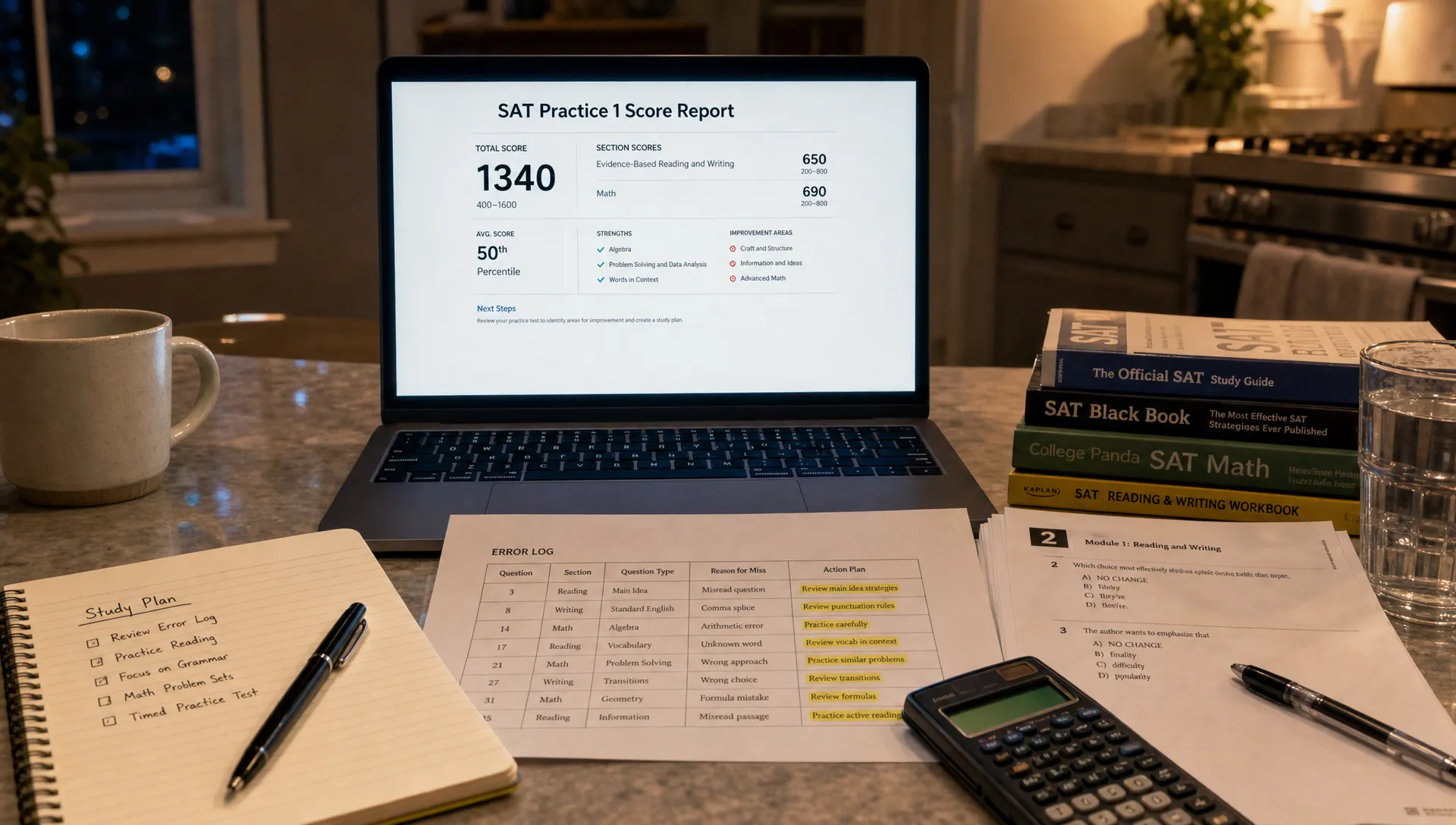
Taking more SAT practice tests is not enough. Learn how to turn each test into a score-raising cycle with diagnostics, error logs, targeted drills, and smarter pacing.
SAT practice tests are one of the fastest ways to improve your score, but only if you use them as a feedback tool, not just a scoreboard. Many students take full tests, check the number, feel either relieved or discouraged, and move on. That leaves most of the value on the table.
A practice test should tell you three things: what you know, what you almost know, and what keeps costing you points under time pressure. Once you learn how to read that information, every test becomes a study plan.
Below is a practical system for using SAT practice tests to raise your score, whether you have one month or an entire semester before test day.
Start with one full diagnostic test
Your first practice test is not about proving anything. It is a baseline. Take one full-length digital SAT practice test before you start serious prep so you can see where your score actually stands.
For the most accurate baseline, use official materials when possible. The College Board offers official SAT practice resources, including digital practice through Bluebook and additional questions through the SAT Suite Question Bank. Since the SAT is now digital, practicing in a digital format helps you get used to the timing, tools, and adaptive structure.
Treat this first test like the real exam:
- Take it in one sitting, with only the official breaks.
- Use a quiet space and remove your phone.
- Follow the real section timing.
- Do not pause to look up formulas, definitions, or grammar rules.
- Record your score, section scores, and how you felt during each section.
The digital SAT includes Reading and Writing, followed by Math. Reading and Writing has 54 questions across 64 minutes, while Math has 44 questions across 70 minutes. Knowing the real pacing matters because many score drops are not caused by lack of knowledge alone. They are caused by slow decisions, second-guessing, or spending too long on one difficult question.
Do not take practice tests too often
More tests do not automatically mean more improvement. If you take a practice test every other day but never study the mistakes, you are mostly practicing the same errors.
A better rhythm is to use full SAT practice tests as checkpoints. Between those checkpoints, focus on targeted drills, concept review, and timed mini-sets.
Here is a simple schedule most students can adapt:
| Prep timeline | Full practice test frequency | What to do between tests |
|---|---|---|
| 1 to 2 weeks | 1 diagnostic and 1 final test | Review high-impact mistakes and drill weak question types |
| 3 to 5 weeks | 1 test per week | Build an error log, review concepts, and complete timed section practice |
| 6 to 12 weeks | Every 2 weeks at first, then weekly near test day | Rotate concept learning, mixed practice, pacing work, and full review |
If your test date is close, you may need a tighter schedule. If you have more time, spacing out practice tests gives you room to actually improve between attempts.
Review every mistake before you study anything new
The review session after a practice test is where the score increase usually happens. Plan to spend at least as much time reviewing the test as you spent taking it. A full digital SAT takes a little over two hours, so a strong review session may take two to three hours.
Do not just read the answer explanation and say, “That makes sense.” That feeling can be misleading. You need to identify why your original answer happened.
For each missed or guessed question, write down:
- The question type or topic.
- The answer you chose.
- The correct answer.
- The reason you missed it.
- The rule, concept, or strategy you need next time.
Most SAT mistakes fall into a few categories. Labeling them helps you spot patterns quickly.
| Mistake type | What it means | Example fix |
|---|---|---|
| Content gap | You did not know the concept | Review the grammar rule, math formula, or reading skill |
| Misread question | You knew the skill but answered the wrong task | Underline exactly what the question asks before solving |
| Trap answer | You picked something partly true but not fully supported | Force yourself to prove the answer from the text or work |
| Pacing issue | You ran out of time or rushed | Practice timed sets and learn when to skip |
| Careless error | You made an avoidable slip | Slow down on setup, units, signs, and answer choice matching |
This turns a disappointing score into useful data. If you missed 12 Math questions and 8 came from linear equations, your next study block is obvious. If you missed mostly Reading and Writing questions because you chose answers that “sounded right,” you need evidence-based reading practice, not more random tests.
Build an SAT error log you will actually use
An error log does not need to be fancy. A spreadsheet, notebook, or digital document works. The key is to keep it short enough that you will maintain it.
Use one row per missed question. Include the test name, section, question number, topic, mistake type, and your takeaway. The takeaway should be specific. “Be more careful” is not helpful. “Check whether the transition shows contrast or cause and effect” is useful.
After two or three practice tests, your error log becomes a map of your score. You will begin to notice patterns like:
- You miss punctuation questions involving semicolons and colons.
- You lose time on long algebra word problems.
- You change correct answers to wrong ones in Reading and Writing.
- You skip too few questions and get stuck.
- You perform well untimed but drop under pressure.
Once you see the pattern, your prep becomes much more efficient. Instead of “study SAT Math,” you can study systems of equations, nonlinear functions, or data analysis. If Math is your biggest opportunity area, StudyInk has a focused guide on how to increase your SAT Math score from 600 to 700 in one month that pairs well with practice test review.
Turn mistakes into targeted drills
After reviewing a practice test, do not immediately take another one. First, convert your mistakes into practice sets.
If you missed transition questions, drill transitions. If you missed functions, drill functions. If you lost points on words in context, practice vocabulary-in-context questions. This is how you turn test feedback into score growth.
A useful cycle looks like this:
- Take a practice test.
- Review every missed, guessed, or slow question.
- Group mistakes by topic and reason.
- Complete targeted drills for the top two or three weaknesses.
- Retake similar question types under time pressure.
- Take another practice test only after you have trained the weak areas.
This cycle matters because the SAT rewards pattern recognition. Many questions test the same core skills in slightly different packaging. When you drill the pattern, you become faster and more confident the next time it appears.
Practice pacing, not just accuracy
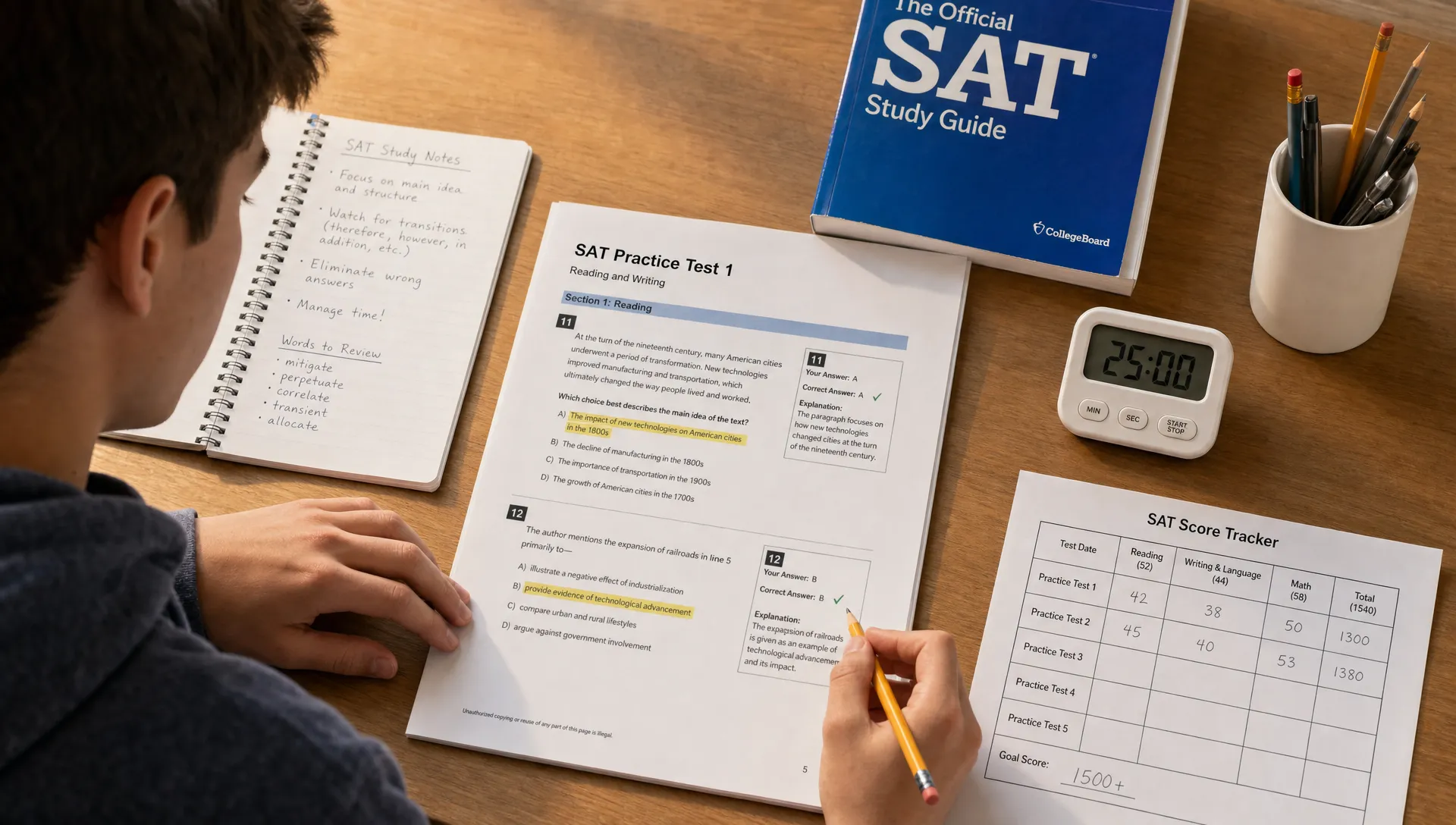
Accuracy without timing is only half the game. A student who can solve every question in unlimited time may still lose points on the real SAT. Your goal is to become accurate at test speed.
For Reading and Writing, the digital SAT gives you short passages with one question each. This format rewards quick comprehension and precise answer choice elimination. If you notice that you spend too long rereading, practice setting a soft time limit per question and moving on when you are stuck.
For Math, pacing problems often come from over-solving. Sometimes you can use answer choices, estimation, graph behavior, or substitution to move faster. Other times, the best strategy is to skip a difficult question, collect easier points, and return later.
Try tracking questions in three categories during practice:
- Fast and confident.
- Correct but slow.
- Missed, guessed, or confusing.
The “correct but slow” category is especially important. Those questions may not hurt your score during relaxed practice, but they can damage your timing on test day. Review them for faster methods.
Use official and realistic practice questions
Not all practice tests are equal. The best practice tests for SAT prep should match the current digital SAT in difficulty, structure, and question style. Official College Board materials are valuable because they reflect the exam most closely.
That said, official full-length tests are limited, so use them carefully. Save at least one for the final week before your exam. In between full tests, use realistic question sets, targeted drills, and review tools.
StudyInk is built for this kind of study loop. You can turn topics, PDFs, or videos into structured lessons, then practice with SAT questions, track progress, and get help when a concept is not clicking. If you want your prep in one place, the free StudyInk learning platform can help you move from test results to lessons, drills, and support without starting from scratch every time.
Know what to review for each section
The SAT is not one big skill. Reading and Writing and Math require different review strategies.
Reading and Writing review
For Reading and Writing, do not review only the passage. Review the decision. Ask yourself what made the correct answer right and what made your answer wrong.
For command of evidence questions, the correct answer must be directly supported by the text or data. For grammar questions, the correct answer must follow a rule, not just sound natural. For transitions, the correct choice must match the relationship between ideas.
Common Reading and Writing review questions include:
- Did I answer the exact question asked?
- Did I rely on outside knowledge instead of the text?
- Did I choose an answer that was too broad or too extreme?
- Did I know the grammar rule being tested?
- Did I eliminate wrong answers for clear reasons?
Math review
For Math, rewrite the problem setup before reading the explanation. Many students understand the solution once they see it, but they do not learn how to start the problem next time.
Ask yourself where the mistake began. Was it translating words into equations? Choosing the wrong formula? Making an arithmetic slip? Forgetting that the calculator could help? Each cause leads to a different fix.
For every missed Math question, write a one-sentence “next time” rule. For example: “When a question asks for the value of an expression instead of a variable, solve only as far as needed.” That kind of note trains strategy, not just content.
Retake missed questions the right way
Retaking missed questions can be powerful, but only if you wait long enough that you are solving, not remembering. After reviewing a practice test, mark the missed questions and return to them three to seven days later.
Cover the explanation and redo the question from scratch. If you get it right, explain why the correct answer works and why your old answer fails. If you miss it again, the issue is not fixed yet. Add it to your next drill set.
This is especially useful for recurring SAT patterns, such as punctuation, linear equations, function notation, data interpretation, and main idea questions.
Simulate test day before the real test
At least once before your official SAT, take a full practice test exactly like test day. Wake up at the same time, eat the same kind of breakfast, use the same calculator, and follow the same break schedule.
This final simulation helps you test more than content. It shows whether your pacing plan, sleep schedule, focus, and endurance are ready. If you are surprised by fatigue during the second half of the test, you still have time to adjust.
The final practice test is also a chance to refine your personal rules. For example:
- Skip a question if you have no clear path after 45 to 60 seconds.
- Flag questions that require long calculations.
- Do not change an answer unless you can name the specific error.
- Use remaining time to check high-risk questions first.
Your rules should come from your own practice test data. The strategy that helps one student may not help another.
What to do if your score is not improving
If your SAT practice test scores stay flat, do not panic. Plateaus are normal. They usually mean your study method needs to change.
First, check whether you are reviewing deeply enough. If you take tests but do not maintain an error log, your practice is probably too passive. Second, check whether you are drilling your top weaknesses or just doing random questions. Third, compare your untimed and timed performance. If untimed accuracy is high but timed accuracy is low, pacing is the problem.
You may also need outside feedback. A peer tutor, study partner, or teacher can often spot habits you miss, such as skipping important words, rushing setup, or using inefficient Math methods. StudyInk includes peer tutoring sessions and live whiteboard collaboration, which can be useful when an explanation alone is not enough.
A simple weekly SAT practice test plan
Here is a practical weekly structure for students who have at least four weeks before the exam.
| Day | Focus | Goal |
|---|---|---|
| Monday | Review your latest practice test | Identify top mistakes and update your error log |
| Tuesday | Targeted Reading and Writing drills | Fix one or two question types |
| Wednesday | Targeted Math drills | Strengthen your weakest Math topic |
| Thursday | Timed mixed practice | Improve pacing and switching between question types |
| Friday | Redo missed questions | Confirm that old mistakes are improving |
| Saturday | Full practice test or section test | Measure progress under realistic conditions |
| Sunday | Light review and rest | Reset before the next study cycle |
You can adjust the days, but keep the pattern: test, review, drill, retest. That cycle is what raises scores.
Frequently Asked Questions
How many SAT practice tests should I take before the real exam? Most students benefit from at least 3 to 5 full-length practice tests, depending on their timeline. The key is to review each one thoroughly and study weaknesses before taking the next test.
Are official SAT practice tests better than third-party tests? Official practice tests are the closest match to the real SAT, so they should be your highest-priority checkpoints. Third-party or platform-based drills can still be useful for extra practice, especially when they target specific skills.
Should I review questions I got right? Yes, especially if you guessed, felt unsure, or took too long. A correct answer can still reveal a pacing issue or a concept that needs reinforcement.
How long should I spend reviewing an SAT practice test? Plan for two to three hours of review after a full test. If you are building a detailed error log and reworking missed questions, the review may take longer than the test itself.
Can SAT practice tests raise my score in one month? Yes, but only if you use them strategically. In a short timeline, take a diagnostic, identify the highest-impact weaknesses, drill those skills, and use one or two additional practice tests to measure progress.
Turn each practice test into a smarter study plan
The students who improve the most do not just take more SAT practice tests. They learn from every question, track patterns, and practice the skills that will return the most points.
If you want a better way to move from score report to study plan, StudyInk can help you turn lessons, topics, and practice into a structured prep routine with AI study help, SAT practice, progress tracking, and peer support. Use your next practice test as a starting point, then let every mistake point you toward your next score increase.