August 3, 2026
SAT Math Prep Questions That Build Speed and Accuracy
Keyword: sat prep questions math
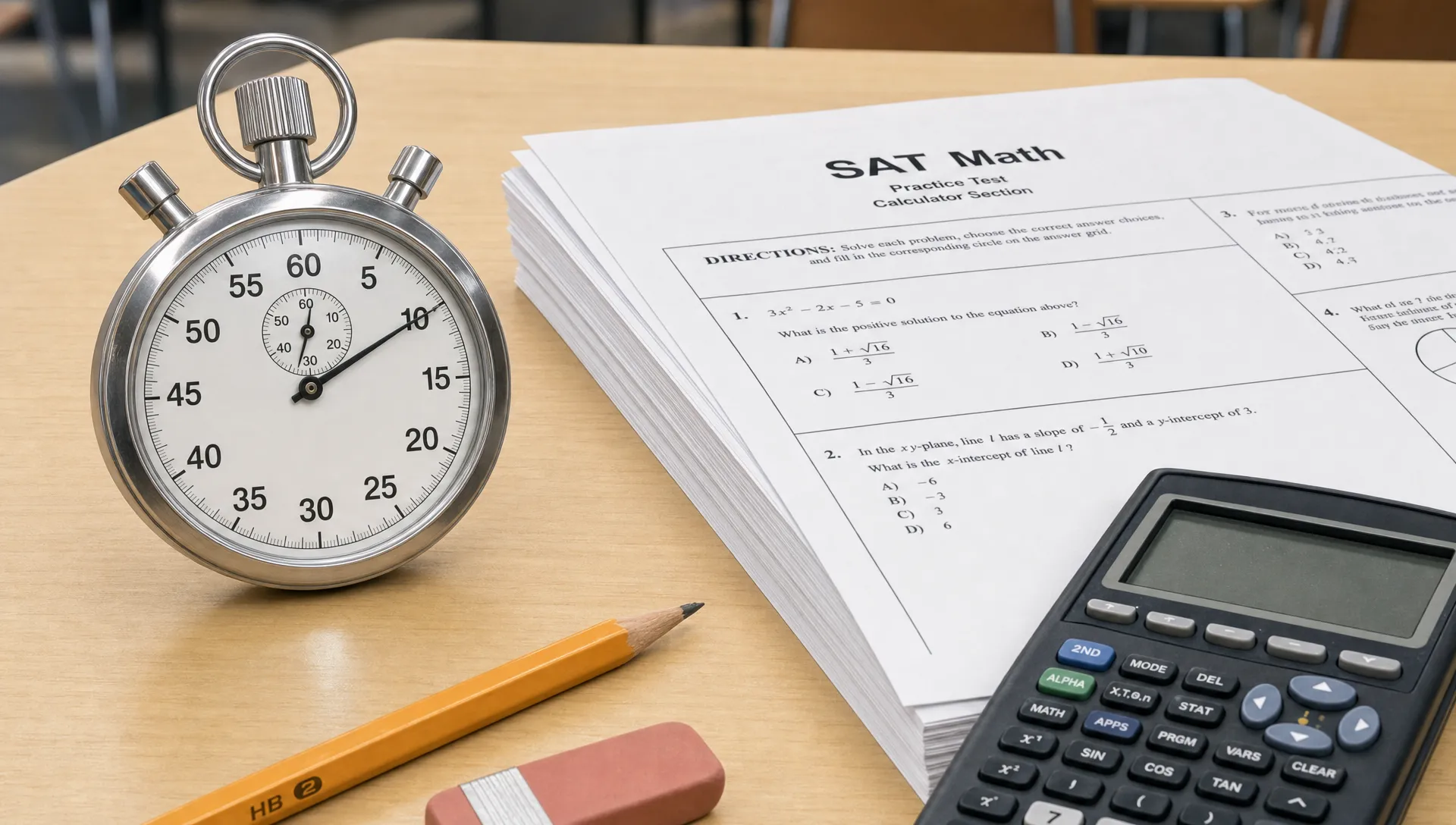
Speed on SAT Math comes from recognizing patterns, not rushing. Use this timed question set, answer explanations, and review system to cut careless errors while building confidence for test day.
Good SAT Math practice is not just about doing more problems. The real goal is to train two habits at the same time: recognizing the fastest path and protecting yourself from careless mistakes.
That matters even more on the digital SAT. The Math section has 44 questions across 70 minutes, which works out to about 95 seconds per question on average. But strong test takers do not spend 95 seconds on every question. They finish easier algebra and data questions quickly, then save time for the multi-step problems that appear later in a module.
The SAT Math prep questions below are designed for that exact purpose. Use them as a timed drill, then study the answer explanations to see where speed came from and where accuracy could break down.
Why speed and accuracy are connected on SAT Math
Speed on SAT Math does not mean rushing. Rushing usually creates sign errors, misread graphs, and wrong answers to questions you actually know how to solve. Real speed comes from recognition.
When you see a linear equation, you should know whether to isolate the variable, substitute, or use answer choices. When you see a quadratic, you should recognize whether factoring, the discriminant, a graph, or a shortcut is fastest. When you see a percent change question, you should immediately think in multipliers, not in vague phrases like “20 percent off.”
According to the College Board SAT Math overview, the test focuses on four major domains: Algebra, Advanced Math, Problem-Solving and Data Analysis, and Geometry and Trigonometry. A balanced practice plan should hit all four, but your pacing strategy should be different for each.
| SAT Math domain | What it often tests | Speed habit to build | Accuracy habit to build |
|---|---|---|---|
| Algebra | Linear equations, systems, inequalities | Solve by substitution or elimination without over-writing steps | Check signs and distribute carefully |
| Advanced Math | Quadratics, nonlinear equations, functions | Recognize factoring, vertex form, and function patterns | Confirm what the question asks, not just what you found |
| Problem-Solving and Data Analysis | Ratios, percentages, units, tables, statistics | Convert words into equations or multipliers quickly | Track units and totals |
| Geometry and Trigonometry | Area, volume, angles, right triangles, circles | Memorize common formulas and triples | Label diagrams before calculating |
The best SAT Math practice questions are not always the hardest ones. They are the questions that force you to choose a method quickly, execute cleanly, and verify the answer before moving on.
How to use this SAT Math question set
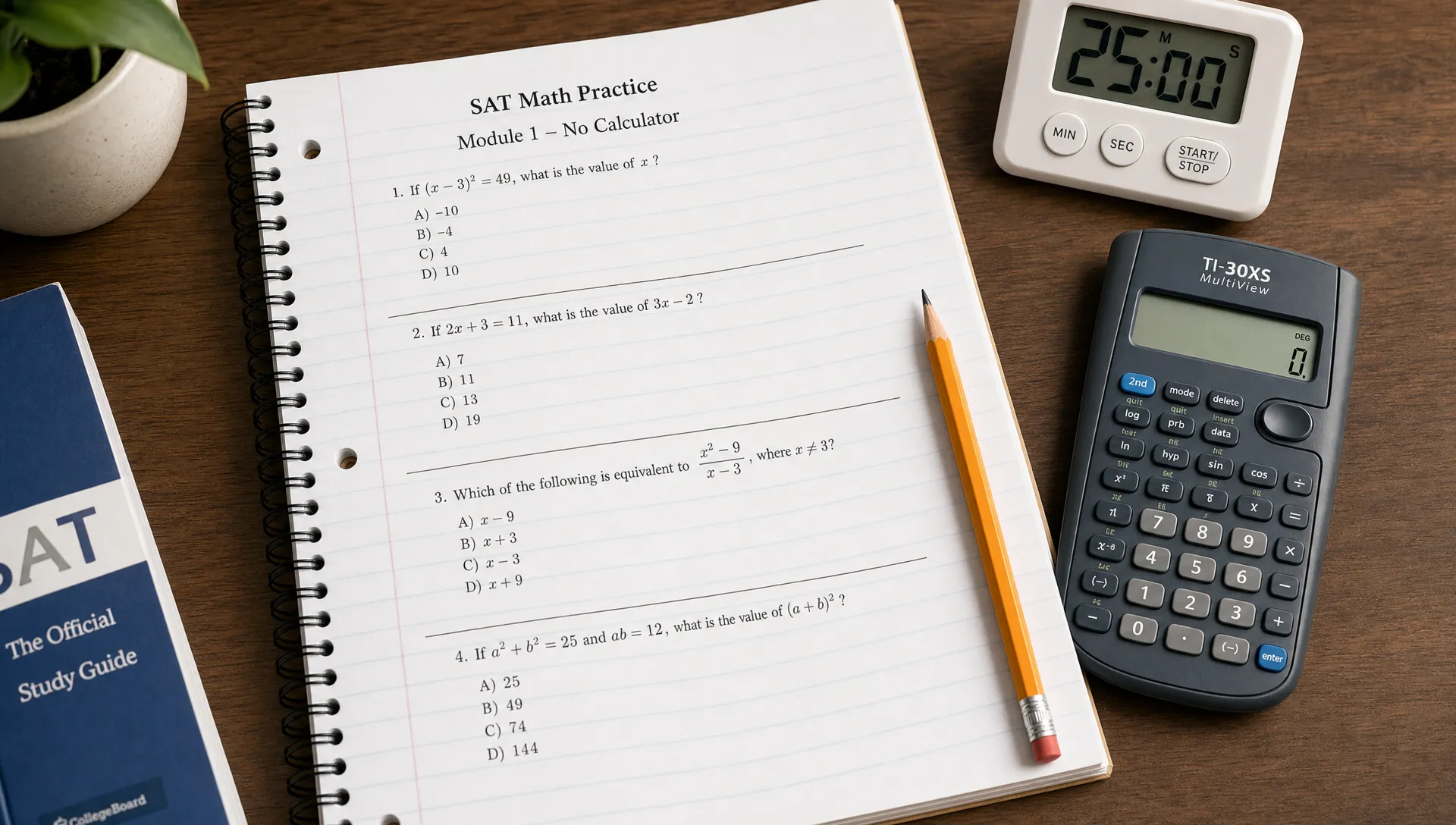
Set a timer for 15 minutes and answer the 12 questions without pausing to check solutions. That is slightly faster than official average pacing, but the set includes several questions that should take less than a minute.
After the timer ends, do not just mark questions right or wrong. Write down the reason for every miss or slow solve. Use these three labels:
- Recognition mistake: You did not identify the fastest method.
- Process mistake: You chose a workable method but took too many steps.
- Careless mistake: You understood the problem but made an arithmetic, sign, copying, or reading error.
This review step is where score improvement happens. If your current score is around the low-to-mid 600s and you want a bigger pacing plan, StudyInk’s guide on how to increase your SAT Math score from 600 to 700 in one month pairs well with this drill.
12 SAT Math prep questions for speed and accuracy
Try to complete the full set in 15 minutes. If a question takes more than 90 seconds, mark it and move on. On the actual SAT, skipping strategically and returning later can protect both your time and your score.
- Linear equation: If (3(2x - 5) + 4 = 25), what is the value of (x)?
- Slope and intercept: A line passes through ((2, 5)) and ((6, 13)). If the line is written as (y = mx + b), what is the value of (b)?
- Percent change: A price is decreased by 20% and then increased by 25%. The final price is what percent of the original price?
- System of equations: If (y = 2x + 7) and (y = -x + 1), what is the value of (x)?
- Function notation: If (f(x) = x^2 - 3x), which expression is equivalent to (f(a + 1) - f(a))?
- Quadratic roots: The solutions to ((x - 4)(x + 6) = 0) are (p) and (q). What is the value of (pq)?
- Exponential model: A population is modeled by (P = 1200(1.05)^t), where (t) is the number of years after the initial measurement. By what percent does the population increase each year?
- Mean: Five numbers have a mean of 18. If a sixth number, 30, is added to the set, what is the new mean?
- Right triangle: A right triangle has legs of length 6 and 8. What is the length of the hypotenuse?
- Trigonometry: In a right triangle, angle (A) is acute and (\sin A = \frac{7}{25}). What is (\cos A)?
- Function value: If (g(x) = 2x^2 + bx + 8) and (g(2) = 0), what is the value of (b)?
- Discriminant: For what value of (k) does the equation (x^2 - 6x + 5 = k) have exactly one real solution?
Answer key with fastest routes
Check your answers, but pay more attention to the method than the final number. If your answer is right but your method took too long, that is still useful information.
| # | Answer | Fastest route | Accuracy check |
|---|---|---|---|
| 1 | 6 | Distribute: (6x - 15 + 4 = 25), so (6x = 36). | Combine (-15 + 4) as (-11), not (-19). |
| 2 | 1 | Slope is (\frac{13 - 5}{6 - 2} = 2). Use (5 = 2(2) + b). | Use the same point consistently when solving for (b). |
| 3 | 100% | Use multipliers: (0.80 \times 1.25 = 1.00). | A 20% decrease and 25% increase can cancel because of the specific multipliers. |
| 4 | -2 | Set expressions equal: (2x + 7 = -x + 1), so (3x = -6). | Do not stop after finding (y) if the question asks for (x). |
| 5 | (2a - 2) | Expand (f(a + 1)), then subtract (f(a)). | Put parentheses around all of (f(a)) before subtracting. |
| 6 | -24 | Roots are (4) and (-6), so the product is (-24). | Remember (x + 6 = 0) gives (x = -6). |
| 7 | 5% | In (1.05^t), the growth factor is 1.05. | The percent increase is 0.05, or 5%, not 105%. |
| 8 | 20 | Original sum is (5 \times 18 = 90). New sum is 120, and (120 \div 6 = 20). | Recalculate the number of values after adding 30. |
| 9 | 10 | Recognize the 6-8-10 right triangle or use (6^2 + 8^2 = 100). | The hypotenuse is the longest side. |
| 10 | (\frac{24}{25}) | If opposite is 7 and hypotenuse is 25, adjacent is 24. | Since (A) is acute, cosine is positive. |
| 11 | -8 | (g(2) = 2(4) + 2b + 8 = 16 + 2b). Set equal to 0. | Substitute 2 for every (x), including (x^2). |
| 12 | -4 | Rewrite as (x^2 - 6x + 5 - k = 0). One solution means discriminant 0: (36 - 4(5 - k) = 0). | Solve (16 + 4k = 0), so (k = -4). |
What your results mean
If you finished in 15 minutes and missed 0 to 2 questions, this set is probably at or below your current working level. Your next step is to mix these question types with harder multi-step problems, especially quadratics, systems, and data interpretation.
If you missed 3 to 5 questions, slow down your review. Do not immediately jump to harder questions. First, identify whether your misses came from concepts or execution. A student who misses questions 3, 8, and 12 has a different problem than a student who misses questions 1, 4, and 6 because of sign errors.
If you missed 6 or more, practice by domain before doing mixed timed sets. Mixed drills are great for test readiness, but targeted drills are better for rebuilding a weak skill. For example, spend one session only on linear equations, one only on percent and ratio questions, and one only on quadratics.
The key is to keep a mistake log. A simple mistake log should include the question type, your original answer, the correct method, and the reason you missed it. After a week, patterns become obvious. You may discover that you understand the math but lose points when distributing negatives, or that you overuse the calculator on questions that are faster by hand.
How to choose faster methods on SAT Math
Many SAT Math questions can be solved in more than one way. The highest-scoring students are not always doing more advanced math. They are choosing the method that fits the question.
For straightforward linear equations, algebra by hand is usually fastest. For systems with messy decimals or equations that are already in slope-intercept form, graphing can be efficient. For quadratics, factoring is fast when the numbers are friendly, but the discriminant is better when the question asks how many solutions an equation has.
Calculator use is part of speed, but it should not become a reflex. On the digital SAT, the built-in calculator can help with graphing, solving, and checking. Still, opening a calculator for (3(2x - 5) + 4 = 25) is slower than solving mentally or on paper.
| Question situation | Usually fastest method | Why it saves time |
|---|---|---|
| Small integer linear equation | Algebra by hand | Fewer inputs and fewer chances to mistype |
| Percent increase or decrease | Multiplier method | Avoids confusing percent wording |
| Friendly quadratic | Factoring | Gives roots quickly when factors are obvious |
| One-solution quadratic question | Discriminant | Directly answers the question |
| Data table with totals | Write the total first | Prevents averaging or ratio mistakes |
Your goal is not to use the same method every time. Your goal is to decide quickly.
Accuracy traps that slow students down
A lot of SAT Math errors come from small details. The frustrating part is that these mistakes usually happen on questions students “know.” The good news is that they are trainable.
One common trap is answering the wrong variable. In systems questions, the problem may ask for (x), (y), (x + y), or even a coefficient. Circle or underline what the question asks before solving, especially when you are moving quickly.
Another trap is treating percentage changes as simple addition and subtraction. A 20% decrease followed by a 25% increase is not automatically a 5% increase. Use multipliers every time. This habit makes percent questions faster and more accurate.
A third trap is skipping parentheses in function notation. In question 5, the expression (f(a + 1) - f(a)) requires you to subtract the entire expression for (f(a)). Many students get the expansion right, then lose the point by forgetting to distribute the negative.
Before test day, build a personal checklist of your top three traps. Review it before every timed set. This takes less than a minute, but it makes your practice more intentional.
A simple weekly drill plan
You do not need a complicated study schedule to improve. You need consistent practice with feedback. A strong weekly routine can be as simple as three focused sessions.
| Session | Focus | Time | Goal |
|---|---|---|---|
| Session 1 | Targeted skill drill | 30 minutes | Fix one weak domain, such as systems or quadratics |
| Session 2 | Mixed timed set | 20 minutes | Practice switching between question types |
| Session 3 | Review and redo | 30 minutes | Redo missed questions without looking at explanations |
The redo step is especially important. If you can explain a missed question after reading the solution, that is a start. If you can solve it again two days later without help, that is learning.
For best results, rotate your SAT Math prep questions between accuracy-first sets and speed-first sets. Accuracy-first sets should be untimed or lightly timed. Speed-first sets should feel slightly uncomfortable, but not chaotic. If you are guessing on half the questions, the drill is too fast.
Frequently Asked Questions
How many SAT Math prep questions should I do per day? Quality matters more than volume. For most students, 10 to 20 well-reviewed questions per day is better than 50 rushed questions with no mistake log.
What is a good time per SAT Math question? The average is about 95 seconds, but easier questions should often take 30 to 60 seconds. Saving time early gives you more room for harder questions later in the module.
Should I use a calculator on every SAT Math question? No. The calculator is useful, especially for graphing and checking, but many algebra, percent, and geometry questions are faster by hand.
Are hard questions the best way to improve speed? Not always. Speed improves when you recognize common patterns instantly. Medium questions are often the best training ground because they reveal both method choice and accuracy issues.
How do I stop making careless mistakes on SAT Math? Track the exact type of careless error. Common categories include sign mistakes, skipped parentheses, wrong-variable answers, and misread percent changes. Once you know your pattern, you can build a short checklist before each timed set.
Turn SAT Math practice into a smarter study system
SAT Math improvement comes from the cycle of practice, feedback, and targeted review. StudyInk helps you make that cycle easier by turning videos, PDFs, or topics into structured lessons with summaries, key concepts, and practice questions.
You can use StudyInk to build quiz and drill plans, practice SAT and AP questions, track progress, and study with peer support. Instead of collecting random worksheets, turn your weak spots into focused lessons and keep improving one question type at a time.