July 5, 2026
How to Study for a Calculus Exam: A Practical Plan
A practical plan for a calculus exam covering limits, derivatives, integrals, and the fundamental theorem, with formulas, worked examples, and a timed practice schedule.
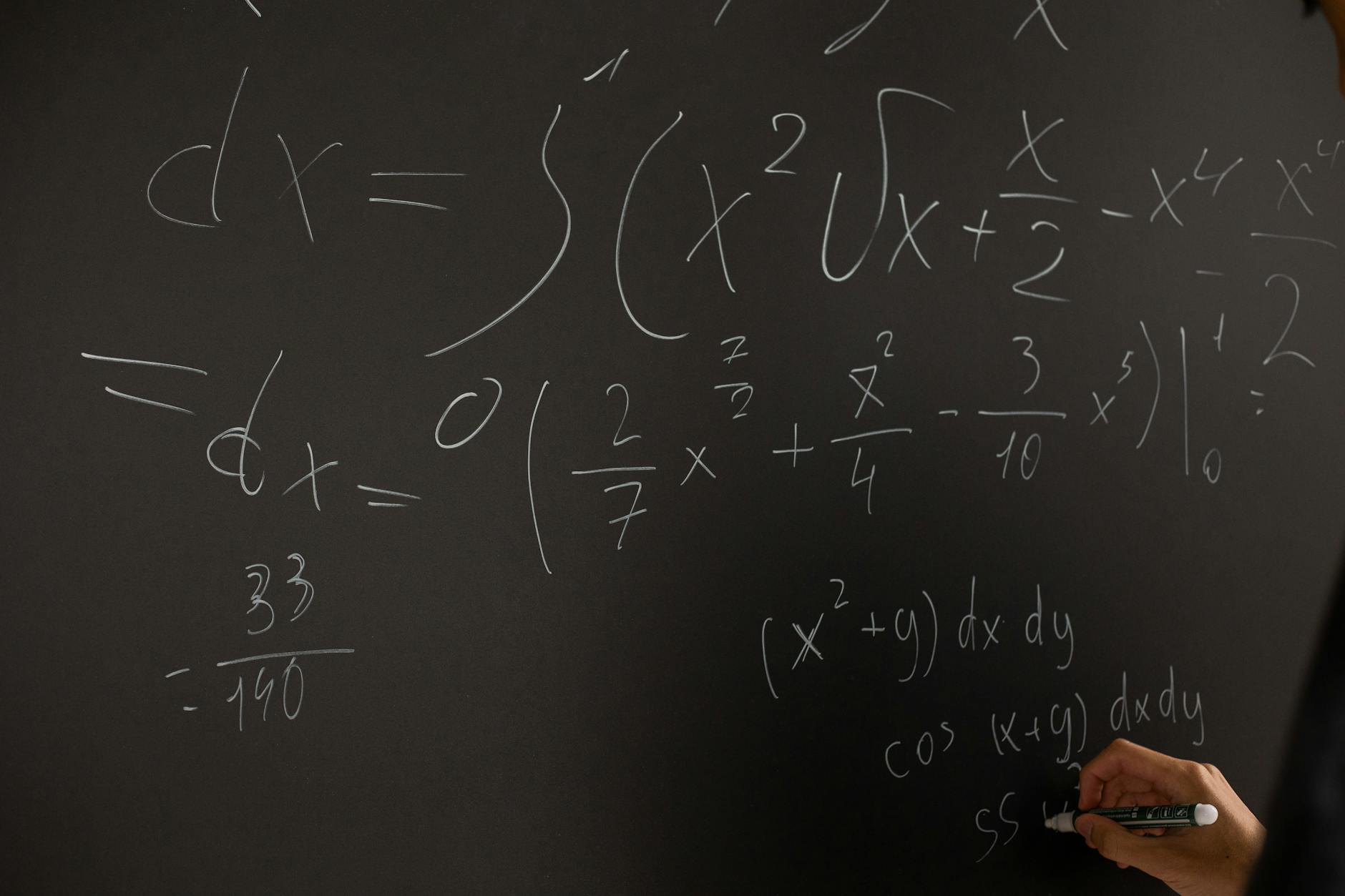
The direct answer: study for a calculus exam by drilling limits, the derivative rules, applications like related rates and optimization, and the integral rules tied to the fundamental theorem, then taking timed mixed problem sets. This guide lists the formulas, shows worked examples, and gives a schedule you can start this week.
Calculus Exam at a Glance
| Category | Details |
|---|---|
| Two big ideas | The derivative (rate of change) and the integral (accumulation). |
| Most used rule | The power rule for derivatives. |
| What connects them | The fundamental theorem of calculus. |
| Best practice method | Mixed timed sets, not topic by topic only. |
| Time to start | Two weeks out, with daily short sessions. |
Start With Limits and Continuity
A limit asks what value f(x) approaches as x nears a. Continuity means the limit equals the function value: the limit of f(x) as x approaches a equals f(a). Students often treat a limit as a value the function actually reaches, but a limit can exist even when the function is undefined at that point. That distinction shows up constantly on exams.
Key facts worth memorizing as anchors: the limit of sine x divided by x as x approaches 0 is 1, and the limit of (1 plus 1/n) to the n as n grows without bound is e, about 2.718. These two show up in harder derivative proofs and in the definition of the derivative itself.
Worked example. Find the limit of (x squared minus 4) divided by (x minus 2) as x approaches 2. Direct substitution gives 0/0, which is undefined. Factor the numerator into (x minus 2)(x plus 2), cancel (x minus 2), and you get x plus 2. The limit is then 4. The function has a hole at x = 2, but the limit still exists.
A 2013 review of study techniques rated practice testing and distributed practice as the highest utility methods across learners and subjects, which for calculus means working mixed problems over several days rather than rereading notes (Dunlosky et al., 2013). Khan Academy's free calculus sequence is a useful place to drill each rule with immediate feedback (Khan Academy Calculus 1). If you are shaky on the algebra underneath, review functions first using how to understand functions.
Master the Derivative
The derivative f prime(x) is the instantaneous rate of change. You need the rules fluent, because every application problem assumes you can differentiate without thinking.
- Power: the derivative of x to the n is n times x to the (n minus 1).
- Constant multiple: the derivative of c times f(x) is c times f prime(x).
- Sum: the derivative of f(x) plus g(x) is f prime(x) plus g prime(x).
- Product: (fg) prime = f prime g + f g prime.
- Quotient: (f divided by g) prime = (f prime g minus f g prime) divided by g squared.
- Chain: the derivative of f(g(x)) is f prime(g(x)) times g prime(x).
Differentiate a composite
Worked example. Differentiate (2x plus 3) squared. Let u = 2x plus 3. By the chain rule, the derivative is 2(2x plus 3) times 2 = 4(2x plus 3) = 8x plus 12.
The chain rule is where most calculus exams separate students who understand from those who memorized. Practice it on functions nested three deep, like sine of (x squared plus 1), until the outer-then-inner habit is automatic.
Apply Derivatives
Derivatives solve real problems, and application questions are usually worth more points than raw differentiation:
- Tangent line: the derivative at a point gives the slope of the line.
- Related rates: differentiate an equation with respect to time.
- Optimization: find where f prime(x) = 0 and test for max or min.
- Motion: velocity is the derivative of position, acceleration is the derivative of velocity.
Optimization worked example
Maximize the area of a rectangle with fixed perimeter 20. Let length L and width W with 2L plus 2W = 20, so L plus W = 10 and W = 10 minus L. Area A = LW = L(10 minus L) = 10L minus L squared. A prime = 10 minus 2L, which is 0 at L = 5. The second derivative is negative 2, confirming a maximum. The shape is a square.
A common mistake is to stop at "f prime = 0" and call it the answer. You must state whether it is a max or min, usually with the second derivative test or by checking endpoints.
Learn the Integral
The integral accumulates area. The power rule for integration is the reverse: the integral of x to the n is x to the (n plus 1) divided by (n plus 1), for n not equal to -1. The integral of 1/x is the natural log of the absolute value of x.
The fundamental theorem of calculus links the two: the definite integral from a to b of f(x) dx equals F(b) minus F(a), where F prime = f. This is the single most tested idea on a calculus exam because it turns a hard area problem into an antiderivative evaluation.
Integration worked example
Find the integral from 0 to 2 of x squared dx. An antiderivative is x cubed over 3. Evaluate: (8/3) minus 0 = 8/3. The same theorem lets you compute displacement from a velocity function, which is why motion problems tie derivatives and integrals together.
Build a Two Week Schedule
Start two weeks out. Short daily blocks beat one long weekend, because spacing helps procedural skills stick.
- Days 1 to 2: Limits and continuity drills, including the two anchor limits above.
- Days 3 to 5: Derivative rules, with extra reps on product, quotient, and chain.
- Days 6 to 7: Applications of derivatives (tangent, related rates, optimization).
- Days 8 to 10: Integral rules and the fundamental theorem.
- Days 11 to 12: Mixed timed sets that combine topics, then fix weak spots.
- Days 13 to 14: Light review of the items you missed, plus one full timed set.
A timed set should mirror the real exam: no notes, no calculator unless allowed, and a clock visible. The point is to rehearse the conditions, not to learn new material.
Common Mistakes
- Forgetting the chain rule on composite functions, especially trig and exponential nests.
- Mixing up the quotient and product rules because they look similar under pressure.
- Dropping the constant of integration on indefinite integrals.
- Treating a limit as always equal to the function value at that point.
- Confusing when to use a derivative versus an integral on an applied problem.
- Stopping at f prime = 0 without classifying the point as max, min, or neither.
Frequently Asked Questions
Is calculus mostly algebra?
Underneath the new ideas, yes. Strong algebra and function skills make calculus far easier, which is why a pre calculus review pays off before exam week.
What is the hardest part for most students?
The chain rule and knowing which technique to apply to a given problem. Both improve only with mixed practice, not with watching solved examples.
Do I need to memorize derivative rules?
Yes, because exams expect fluent use of the power, product, quotient, and chain rules. Write them from memory at the start of each study session until they are automatic.
What is the fundamental theorem in plain terms?
It says that accumulating a rate of change (integration) reverses finding the rate (differentiation). If you know the derivative of F, then the area under that derivative from a to b is F(b) minus F(a).
How is calculus used later?
It supports physics, engineering, economics, and probability. The derivative and integral appear wherever something changes continuously.
Where can I find extra practice problems?
Textbooks, past exams from your teacher, and free sites like Khan Academy all work. The key is to generate problems at your level and check the steps, which is also how logarithms and exponentials connect back to calculus.
Sources
- Dunlosky, J., Rawson, K., Marsh, E., Nathan, M., and Willingham, D. (2013). Improving Students' Learning With Effective Learning Techniques. Psychological Science in the Public Interest. psychologicalscience.org
- Khan Academy. Calculus 1. khanacademy.org
About the author
Daniel O. taught AP Calculus for 13 years and coordinated curriculum across three schools. He writes about the conceptual gaps that cause students to plateau, and the specific fixes that break through them.