July 6, 2026
How to Study for Algebra 2: A Practical Plan
A practical study plan for Algebra 2 covering functions, polynomials, exponentials, logarithms, and systems, with worked examples and a spaced practice schedule.
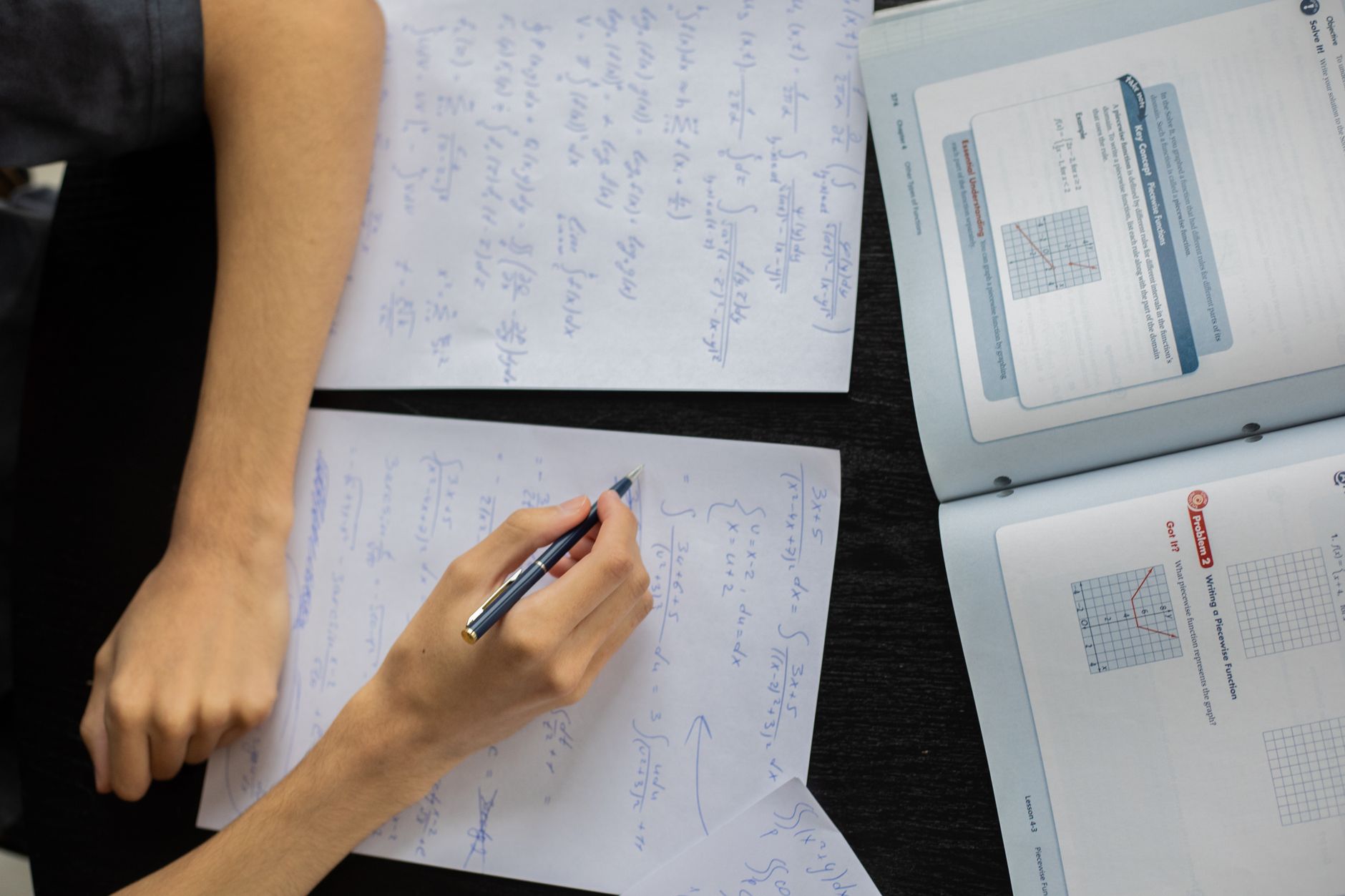
The direct answer: study Algebra 2 by mastering one family of skills at a time, starting with functions and linear systems, then moving to polynomials, exponentials, and logarithms, and testing yourself with real problems after each unit. This plan shows the topics, the formulas that matter, and a practice schedule you can start this week.
Algebra 2 at a Glance
| Category | Details |
|---|---|
| Main shift from Algebra 1 | More functions, complex numbers, and exponential or log models. |
| Skill that underpins everything | Working with functions and their graphs. |
| Memorizing formulas enough | No. You need to choose the right method for each problem type. |
| Best practice method | Short daily retrieval with mixed problem sets. |
| Time to start | Two weeks out, one family of skills per block. |
Start With Functions and Linear Systems
Algebra 2 expands the function idea you saw in Algebra 1. A function takes an input and returns exactly one output. You will graph them, shift them, and combine them. Spend your first week here because later topics reuse the language.
Linear systems appear early. To solve a system like 2x + y = 7 and x - y = 2, you can add the equations to eliminate y. Adding gives 3x = 9, so x = 3, and then y = 1. Check by substitution: 2 times 3 plus 1 equals 7, correct.
Practice this by generating systems and explaining any step you miss. Retrieval beats rereading because the exam asks you to produce the steps, not recognize them. If functions feel shaky, review them directly with how to understand functions.
Master Polynomials and Factoring
Polynomials are sums of terms like 3x squared minus 5x plus 2. Factoring turns them into products, which is how you solve many equations and simplify rational expressions.
Common factoring patterns
- Difference of squares: a squared minus b squared equals (a minus b)(a plus b).
- Perfect square: a squared plus 2ab plus b squared equals (a plus b) squared.
- Trinomial: x squared plus bx plus c factors into (x plus p)(x plus q) when p times q equals c and p plus q equals b.
Worked example. Factor x squared plus 5x plus 6. We need two numbers that multiply to 6 and add to 5. Those are 2 and 3, so the answer is (x plus 2)(x plus 3).
Solve Quadratics With the Formula
When factoring is slow or impossible, use the quadratic formula. For ax squared plus bx plus c equals 0:
x = (-b plus or minus the square root of (b squared minus 4ac)) divided by (2a)
The part under the square root, b squared minus 4ac, is the discriminant. If it is positive you get two real solutions, if zero one real solution, and if negative two complex solutions.
Discriminant worked example
Solve 2x squared minus 4x minus 6 equals 0. Here a = 2, b = -4, c = -6. The discriminant is 16 minus 4 times 2 times -6, which is 16 plus 48 = 64. The square root of 64 is 8. So x = (4 plus or minus 8) divided by 4, giving x = 3 or x = -1.
A 2013 review of study techniques rated practice testing and distributed practice as the highest utility methods across learners and subjects, which for algebra means working mixed problems over days rather than rereading (Dunlosky et al., 2013). Khan Academy's free Algebra 2 sequence is a solid place to drill each family of skills (Khan Academy Algebra 2).
Build Intuition for Exponentials and Logs
Algebra 2 introduces exponential growth and decay, written as y = a times b to the x. When b is greater than 1 the quantity grows; when b is between 0 and 1 it shrinks. Logarithms are the inverse, answering which exponent gives a result. Our separate guide on logarithms explains the rules in full (how to understand exponents).
A useful check: log base b of b equals 1, and log base b of 1 equals 0. These appear often in simplification.
Log rules that trip students
The rule log(a times b) = log a plus log b is real, but log(a plus b) is not log a plus log b. Mixing those up is one of the most common algebra mistakes. Drill the product, quotient, and power rules until they are automatic.
Use Sequences and Rational Expressions
Arithmetic sequences add a constant each step. The nth term is a plus (n minus 1)d, where d is the common difference. Geometric sequences multiply by a constant r, giving a times r to the (n minus 1).
Rational expressions are fractions of polynomials. You simplify by factoring numerator and denominator and canceling common factors, then add, subtract, multiply, or divide them using the same rules as number fractions.
Common Mistakes
- Dropping the plus or minus in the quadratic formula and missing a root.
- Forgetting that a negative discriminant means complex, not "no solution."
- Canceling terms that are added, not multiplied, inside a fraction.
- Mixing up the sign when shifting a graph left or right.
- Treating log(a plus b) as log a plus log b, which is incorrect.
Frequently Asked Questions
Is Algebra 2 harder than Algebra 1?
Most students find it harder because it layers functions, complex numbers, and new function types on earlier skills. Steady practice keeps it manageable.
What grade takes Algebra 2?
In many schools it is a 10th or 11th grade course, often after Geometry.
Do I need to memorize the quadratic formula?
Yes. It applies whenever factoring is awkward, and it is not provided on every test.
How are exponentials used in real life?
They model population growth, bank interest, and radioactive decay, among other situations.
Should I use a calculator for everything?
Use it to check, not to replace understanding. The thinking behind each step is what tests measure.
How do I tie this to pre calculus?
Algebra 2 is the direct foundation for pre calculus. Once functions, logs, and trig feel routine, a pre calculus plan builds on them without reteaching the basics.
Sources
- Dunlosky, J., Rawson, K., Marsh, E., Nathan, M., and Willingham, D. (2013). Improving Students' Learning With Effective Learning Techniques. Psychological Science in the Public Interest. psychologicalscience.org
- Khan Academy. Algebra 2. khanacademy.org
About the author
Marcus B. coached competition math for a decade and scored a perfect 800 on SAT Math. He writes teardowns of test question design, showing students the pattern behind the problem instead of the problem itself.